Customer expectations are higher than ever. They want instant answers, personalized experiences, and effortless support on every channel. Traditional call centers, even with the best human teams, often struggle to keep up. That is where an AI agent call center changes the game, especially as this article on AI call center solutions explores how modern automation transforms customer service.
By combining human empathy with intelligent automation, an AI call center for exceptional customer experience helps you deliver faster, friendlier, and more consistent service — while dramatically reducing operational costs.
Today’s digital systems play a major role in making this possible. Many companies now use easy-to-scale cloud computing platforms for customer support, which allow teams to handle large amounts of data without slowing down. These cloud-based communication tools for service operations also help businesses stay flexible and respond to changing customer needs faster.
More organizations are adopting simple IoT customer connection tools, such as smart device monitoring systems for service updates, to gather real-time information about customer behavior. These insights help AI tools understand context better and offer more helpful responses.
To support all of this, businesses are upgrading to modern computer technology infrastructure for call centers, along with reliable IT system setups for automated support and high-performance digital networks for AI operations. With faster processing and stronger security, these systems help AI run smoothly and keep customer information safe.
Marketing teams are also improving results with AI-friendly digital marketing tools for customer engagement, automated online marketing systems for lead nurturing, and simple machine-learning marketing insights for campaign planning. These tools help brands reach customers more accurately, making support interactions more meaningful and relevant.
Financial operations benefit too. Many companies now use AI-powered financial tracking tools for business planning, automated finance management systems for accurate reporting, and smart forecasting tools for budget decisions. These solutions help leaders understand where resources are needed most—especially in customer support.
When these technologies work together—cloud platforms, IoT tools, upgraded IT systems, AI-based marketing tools, and financial automation—they create a strong digital foundation that makes the move to an ai agent call center easier and more effective for any growing business.
Top 10 AI Agent Call Center Solutions
Choosing the right AI agent call center solution is critical for businesses looking to improve customer service, reduce operational costs, and provide seamless support across multiple channels. Here are the top 10 platforms, starting with Bright Pattern and followed by leading competitors.
1. Bright Pattern: AI Contact Center Solutions
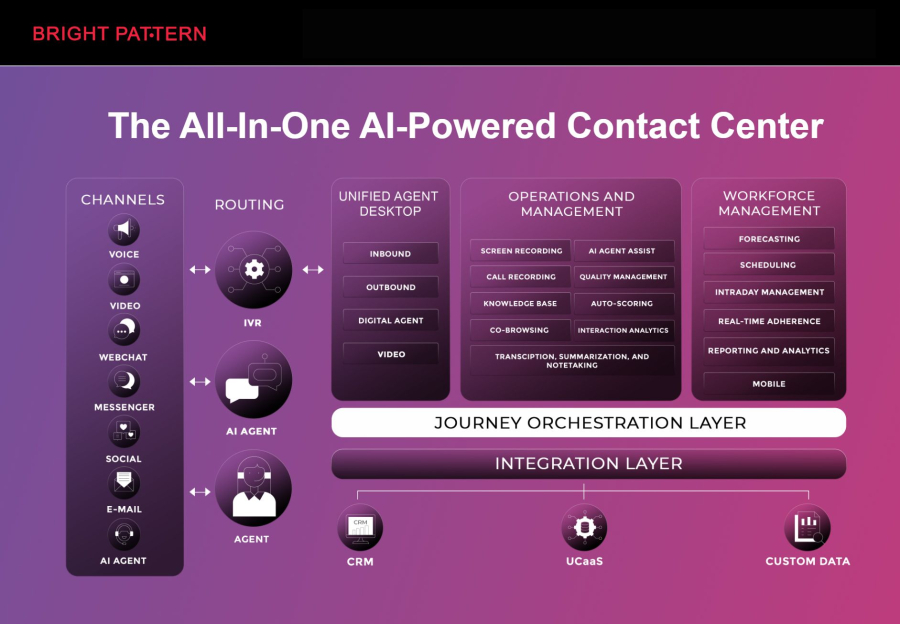
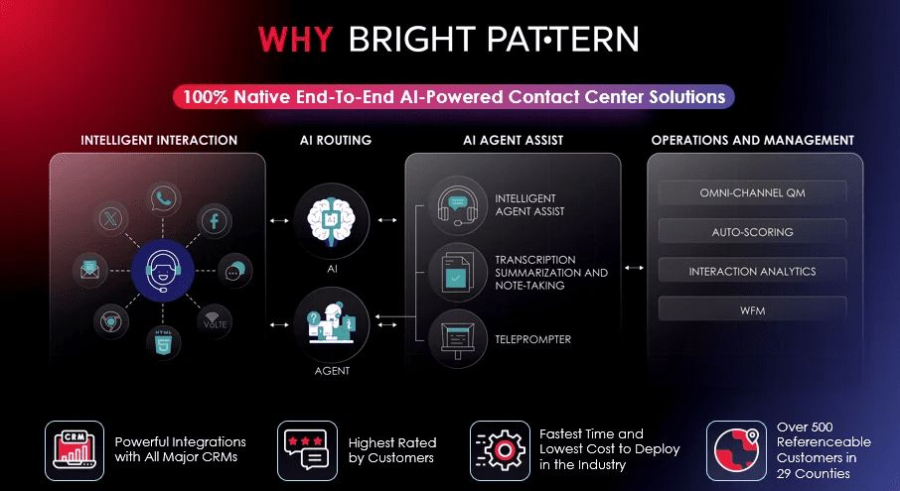
Bright Pattern is a leading provider of AI agent call center solutions, known for its intuitive platform and cloud-based architecture. It enables businesses to deliver personalized, efficient, and consistent support across voice, chat, email, SMS, and social media channels.
Key Features:
- Omnichannel routing for seamless customer interactions across all channels
- AI-powered chatbots and virtual agents for faster response times
- Cloud-based architecture for easy scalability and reliability
- Advanced analytics and reporting to monitor agent performance and customer satisfaction
- Integration with CRM, marketing automation, and financial systems for a unified digital experience
Benefits:
- Reduced average handling time with AI assistance
- Improved first-contact resolution rates
- Cost savings by automating repetitive tasks
- Enhanced customer engagement through predictive and personalized support
Bright Pattern stands out for its user-friendly interface and ability to integrate AI across every step of the customer journey, making it ideal for businesses that want to modernize their contact centers while keeping customer experience a priority.
2. Genesys Cloud CX
Genesys Cloud CX offers AI agent call center capabilities that help businesses manage omnichannel interactions. It combines AI-powered routing, predictive analytics, and virtual assistants to enhance efficiency and customer satisfaction.
3. Five9 Intelligent Cloud Contact Center
Five9 provides a cloud-based platform with AI-driven tools, including virtual agents, real-time speech analytics, and automated workflows, enabling contact centers to improve agent productivity and service quality.
4. NICE inContact CXone
NICE inContact CXone delivers AI agent call center solutions with robust workforce optimization, omnichannel support, and advanced automation to streamline operations and improve customer engagement.
5. Talkdesk CX Cloud
Talkdesk CX Cloud leverages AI and automation to provide smarter call routing, virtual agents, and real-time analytics, helping organizations deliver faster and more personalized support.
6. Amazon Connect
Amazon Connect is a cloud-based contact center solution with AI integration for chatbots, speech recognition, and automated workflows, enabling businesses to scale efficiently and reduce operational costs.
7. RingCentral Contact Center
RingCentral offers an AI-powered cloud contact center that combines omnichannel communications with analytics, automated workflows, and virtual agents to enhance customer service performance.
8. 8x8 Contact Center
8x8 provides a cloud contact center platform with AI features for predictive engagement, intelligent routing, and real-time monitoring to ensure smooth and efficient customer interactions.
9. Zendesk Sunshine Conversations
Zendesk’s AI contact center solutions focus on messaging, chatbots, and AI-powered automation for support teams, helping businesses offer consistent and personalized customer experiences.
10. Avaya OneCloud CCaaS
Avaya OneCloud CCaaS delivers a flexible AI agent call center platform with omnichannel support, AI-driven analytics, and automation tools that improve service efficiency and agent performance.
What Is an AI Agent Call Center?
AnAI agent call centeris a customer service operation that uses artificial intelligence to handle a significant share of customer interactions. Instead of relying solely on human agents, it deploys intelligent virtual agents that can understand natural language, answer questions, complete tasks, and hand off complex issues to humans when needed.
AI agents can work across voice, chat, messaging, and even email. They can do things like:
- Greet customers and understand why they are contacting you.
- Authenticate identities and retrieve account details.
- Answer common questions with accurate, up-to-date information.
- Guide customers step by step through processes or troubleshooting.
- Complete transactions, bookings, or changes in your existing systems.
- Escalate to the right human agent with full context when necessary.
The result is a hybrid model whereAI handles routine, repetitive workandhuman agents focus on high-value, high-empathy conversations.
Why AI Agents Belong in Modern Call Centers
AI agents unlock a wide range of tangible benefits for both customers and businesses. Here are the most impactful advantages.
1. 24/7 Availability Without Burnout
AI agents never sleep, never take breaks, and never get tired. They can provideround-the-clock support, including nights, weekends, and peak seasons, without the cost of staffing every hour with human teams.
This always-on support means customers can:
- Check order status late at night.
- Reset passwords instantly.
- Get basic troubleshooting help without waiting for business hours.
For your brand, this translates into higher satisfaction and stronger loyalty, especially from customers in different time zones or with non-standard schedules.
2. Dramatically Reduced Wait Times
Long queues and “Your call is important to us” messages frustrate customers and hurt brand perception. AI agents canhandle thousands of interactions in parallel, absorbing spikes in volume and keeping wait times low.
Even when a customer needs to speak with a human, AI agents can:
- Capture intent and essential details during the initial interaction.
- Route the case to the right agent or department.
- Provide the agent with a summary so they can help faster.
This cuts down overall handle time and ensures that customers feel looked after instead of left in limbo.
3. Consistent, Accurate Answers Every Time
Human agents bring empathy and judgment, but they are also subject to fatigue, knowledge gaps, and inconsistency. Well-trained AI agents rely on a centralized knowledge base and defined logic, so they can deliverconsistent, compliant answersacross every interaction.
When knowledge changes — for example, a new policy, pricing plan, or procedure — you can update it once and have every AI interaction reflect the new information. This reduces errors and rework, while protecting brand and regulatory compliance.
4. Lower Cost per Contact
Because AI agents can handle high volumes of routine contacts without requiring one-to-one staffing, they significantly reduce thecost per interaction.
Typical cost improvements come from:
- Automating repetitive tasks like balance checks, order tracking, and simple changes.
- Deflecting basic queries away from live agents.
- Shortening call durations through faster data access and pre-qualification.
- Reducing training and onboarding time for new human agents, who now only handle complex issues.
Instead of hiring more staff to keep up with volume, you can scale your AI agents and deploy human expertise where it truly matters.
5. Happier, More Productive Human Agents
AI agents are not about replacing people; they are aboutaugmenting your team. By taking over repetitive work, they free up human agents for:
- Complex problem-solving and escalations.
- High-value consultative conversations.
- Retention, upsell, and relationship-building opportunities.
Agents spend less time on tedious tasks and more time using their skills — leading tohigher job satisfaction, lower burnout, and better performance.
How AI Call Center Agents Actually Work
Behind the scenes, AI agents rely on several core technologies working together. Understanding these helps you design and deploy them more effectively.
Core Components of an AI Agent Call Center
- Automatic Speech Recognition (ASR)for voice. This converts what a caller says into text the system can understand.
- Natural Language Understanding (NLU). This layer interprets the meaning and intent behind the words, such as “I want to cancel my order” or “My internet is dropping.”
- Dialogue Management. This engine decides how the AI agent should respond, which questions to ask next, and when to escalate to a human.
- Integrations and APIs. These connect the AI agent to your CRM, ticketing system, billing platform, and other tools, so it can actually do things, not just talk.
- Text-to-Speech (TTS)for voice. This converts the AI agent’s response into natural-sounding speech for callers.
- Analytics and Reporting. This tracks performance, identifies automation opportunities, and reveals where customers get stuck.
Traditional vs. AI-Enhanced Call Center at a Glance
Aspect | Traditional Call Center | AI-Enhanced Call Center |
Availability | Primarily business hours, with higher costs for extended coverage. | 24/7 coverage using AI agents, humans for scheduled or complex work. |
Scalability | New staff must be hired and trained for volume spikes. | AI agents scale quickly to absorb surges in contacts. |
Customer Wait Times | Queues during peak hours; service level agreements under pressure. | Lower queues; AI handles many issues immediately. |
Consistency of Answers | Depends on individual agent knowledge and training. | Standardized responses based on a single source of truth. |
Agent Experience | High volume of repetitive questions leads to fatigue. | AI handles routine work; humans focus on rewarding tasks. |
Cost Structure | Primarily labor-based, scaling linearly with volume. | Blend of automation and human expertise; better cost per contact. |
High-Impact Use Cases for AI Call Center Agents
AI agents shine in tasks that are frequent, well-defined, and data-driven. Here are some of the most valuable ways organizations use them today.
Self-Service for Common Questions
- Order status and delivery tracking.
- Billing questions and balance inquiries.
- Password resets and account access help.
- Store hours, location details, and basic product information.
Instead of waiting for a human, customers get instant answers — and your agents avoid answering the same questions hundreds of times a day.
Appointment and Reservation Management
- Booking, changing, or canceling appointments.
- Sending confirmations and reminders.
- Collecting required information before the appointment.
Healthcare providers, service businesses, and logistics companies often achieve significant efficiency improvements with automated scheduling and reminders.
Technical Support Triage
- Gathering basic device or account details at the start of a support call.
- Walking customers through first-line troubleshooting steps.
- Identifying whether the issue is simple (and solvable by AI) or complex (and needs human support).
This ensures customers with complex problems reach the right experts faster, while simple issues are resolved without ever reaching a human queue.
Order Management and Changes
- Address changes before shipment.
- Updating delivery preferences.
- Checking product availability.
When integrated with your order systems, AI agents can instantly pull up order details and apply changes with customer consent, reducing back-and-forth interactions.
Outbound Notifications and Proactive Service
- Automated reminders for payments, renewals, or appointments.
- Proactive alerts about delays, disruptions, or service changes.
- Follow-up messages asking if a recent issue was fully resolved.
AI agents help you shift from reactive support toproactive customer care, which strengthens relationships and reduces inbound call volumes.
Step-by-Step: Implementing AI Agents in Your Call Center
Successful AI deployments do not happen by accident. They follow a clear roadmap that balances technology, process, and people.
1. Define Clear Business Goals
Start by identifying what you want to achieve. Examples include:
- Reducing average wait time by a specific target.
- Improving customer satisfaction scores.
- Lowering cost per contact.
- Extending support hours without expanding headcount.
These goals will shape which use cases you prioritize and how you measure success.
2. Select the Right Use Cases
Look for interactions that are:
- High volume and repetitive.
- Structured and rule-based.
- Supported by reliable data in your systems.
Typical starting points include FAQs, order status, simple billing questions, and password or account support. It is usually better to start with a focused scope and expand gradually.
3. Map the Customer Journeys
Before building anything, map out how customers currently move through your processes:
- What are the common entry points (phone, chat, messaging)?
- Which steps are painful or slow?
- Where are agents repeating the same actions?
This helps you design AI conversations that feel natural and remove friction instead of simply replicating existing pain points.
4. Integrate with Your Core Systems
To move beyond simple Q&A, your AI agents need access to:
- Customer relationship management records.
- Ticketing or case management systems.
- Billing, order, or booking platforms.
- Knowledge bases and policy repositories.
Secure, well-documented integrations allow AI agents to retrieve and update data in real time, so they can act on customer requests, not just respond to them.
5. Design Conversational Flows
AI agents should sound clear, confident, and helpful. Focus on:
- Simple, human language that avoids jargon.
- Short prompts and step-by-step guidance.
- Polite confirmations (for example, repeating key details back to the customer).
- Graceful handling when the system does not understand (“Let me rephrase that”).
Test your flows with real users to see where they get confused or drop off, and refine accordingly.
6. Define Escalation Rules
AI agents should never be a dead end. Define precisely when and how they pass conversations to human agents, such as:
- When customers explicitly ask for a person.
- When the AI fails to understand after a small number of attempts.
- When compliance or risk criteria are triggered.
Include a smooth handoff that shares the conversation history and context so customers do not have to repeat themselves.
7. Launch, Measure, and Iterate
Deploy your AI agents in phases, perhaps with a limited set of intents or a subset of customers. Track performance, collect feedback, and iterate quickly. Over time, you can expand coverage across more tasks, channels, and languages.
Best Practices for Successful AI Agent Deployments
Organizations that see the strongest results from AI agent call centers tend to follow several key practices.
Start Small, Then Scale
Begin with a tightly defined use case where automation will clearly reduce friction. Prove value quickly, then reinvest the savings into expanding AI capabilities across the customer journey.
Always Offer a Path to a Human
Customers feel more comfortable with AI when they know they can reach a person if needed. Make it easy to say things like “talk to an agent” and ensure the transition is quick and seamless.
Be Transparent About AI Use
Clearly tell callers or chat users when they are interacting with an AI agent. Transparency builds trust and sets realistic expectations. Many customers are perfectly happy to use AI as long as it helps them solve problems quickly.
Design for Voice and Chat Separately
Voice interactions and text interactions follow different patterns. For voice, shorter prompts and fewer options work best. For chat, customers are more comfortable reading quick lists or instructions. Tailor your conversational flows to each channel.
Continuously Improve Based on Data
Use analytics to identify:
- Top intents that customers bring to your AI agents.
- Points where conversations frequently fail or escalate.
- Common phrases or language your AI does not yet handle well.
Feed these insights back into training data, knowledge bases, and conversation designs so your AI agents grow more capable over time.
Metrics That Demonstrate the Value of AI Agents
To understand the impact of an AI agent call center, track clear, quantifiable metrics before and after implementation. Common success indicators include:
Operational Metrics
- Containment Rate: The percentage of interactions fully handled by AI without needing a human.
- Average Handle Time (AHT): How long it takes to resolve a customer inquiry, including AI and human segments.
- First Contact Resolution (FCR): How often issues are fully resolved in a single interaction.
- Service Level Adherence: Percentage of contacts answered within target timeframes.
- Cost per Contact: The average cost to handle a single interaction.
Customer Experience Metrics
- Customer Satisfaction (CSAT)after AI interactions and after human-assisted ones.
- Net Promoter Score (NPS)trends following AI deployment.
- Customer Effort Score (CES)to gauge how easy it feels to get help.
- Qualitative feedback and comments about AI responsiveness and clarity.
When these metrics move in the right direction, you gain strong evidence that AI agents are not just a technology upgrade — they are a strategic advantage.
Common Concerns About AI Call Center Agents — And How to Address Them
As with any powerful technology, AI agents raise important questions. Addressing them proactively helps you build a sustainable, trusted solution.
“Will AI Replace Human Agents?”
In practice, most organizations use AI toaugment, not replace, their teams. Routine and repetitive work shifts to AI agents, while human agents handle complex, emotional, or sensitive situations. Many companies use AI-driven efficiency to reinvest in better training, career paths, and working conditions for their staff.
“What About Data Privacy and Security?”
Responsible AI deployments follow strict security and privacy practices, such as:
- Encrypting data in transit and at rest.
- Limiting access based on roles and need-to-know.
- Respecting regional data protection regulations.
- Implementing audit trails for sensitive actions.
By working closely with your security and compliance teams, you can design AI agents that enhance, rather than weaken, your risk posture.
“Will Customers Get Frustrated with AI?”
Customer frustration usually arises when AI is overpromised or poorly designed. By focusing on clear use cases, straightforward language, and easy access to human help, you can deliver AI experiences that feel fast, friendly, and useful. Many customers actually prefer AI for simple tasks because it is quicker than waiting in a queue.
“How Accurate Are AI Agents?”
Accuracy depends on the quality of your training data, knowledge base, and conversation design. With thoughtful implementation and iterative improvement, AI agents can reach very high accuracy on targeted use cases. The key is to monitor performance continuously and refine areas where misunderstandings occur.
The Future of AI Agent Call Centers
AI in customer service is evolving quickly. An AI agent call center you build today can grow into an even more powerful platform over time. Emerging trends include:
- Omnichannel Orchestration: AI agents that follow a customer across phone, chat, email, and messaging without losing context.
- Hyper-Personalization: Tailoring responses and offers based on history, preferences, and real-time behavior.
- Advanced Sentiment Detection: Recognizing when a customer is frustrated or delighted and adapting tone or escalation paths accordingly.
- Multilingual Support: Offering fluent help in multiple languages without needing separate teams for each.
- Deeper Back-Office Automation: Extending AI from the contact center to the processes behind it, reducing manual follow-up work.
Organizations that embrace AI agents now are laying the foundation for a future where customer service is not just a cost center, but a key driver of growth and loyalty.
Conclusion: Turn Your Call Center into a Strategic Advantage
An AI agent call center is more than a technology upgrade — it is a new operating model for customer experience. By combining intelligent virtual agents with skilled human teams, you can:
- Deliver faster, 24/7 support that delights customers.
- Reduce operational costs while improving quality.
- Empower human agents to focus on the work that truly needs their expertise.
- Build a scalable, future-ready service organization.
As expectations continue to rise, the organizations that thrive will be those that turn their call centers into agile, AI-powered hubs of customer value. With the right strategy, your AI agents can become some of your brand’s most reliable, effective, and customer-friendly team members.
